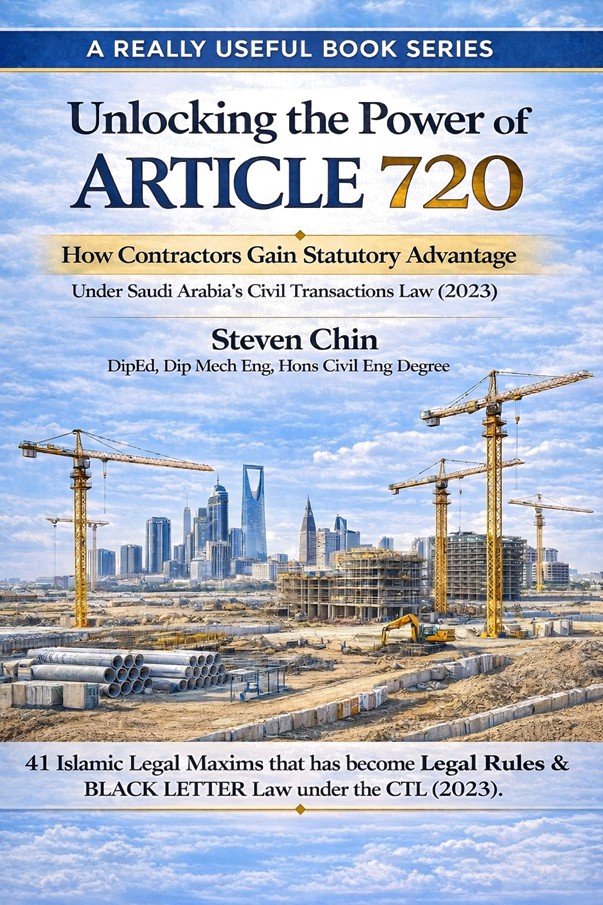
Unlocking the Power of Article 720
One-Line Description
A contractor-focused practical guide explaining how the 41 statutory legal maxims under Article 720 can be used to counter unfair contract terms, improve claims success, and strengthen commercial protection in Saudi construction projects.
Read Executive Summary
Unlocking the Power of Article 720 is a practical construction law guide that explains how contractors can use the 41 Islamic Legal Maxims codified under Article 720 of Saudi Arabia's Civil Transactions Law (2023) to protect themselves against unfair contract terms and excessive risk transfer.
The book's central message is simple:
For the first time, contractors in Saudi Arabia have statutory legal tools that may be used to challenge unfair contractual provisions, even where those provisions were freely agreed and signed.
The book begins by explaining the relationship between Statutory Law, Contract Law, Common Law, Civil Law, and Sharia Law, before introducing the 41 codified legal maxims now recognised as binding law under Article 720.
It then examines each of the 41 Rules individually, explaining:
- What the Rule means
- When it applies
- Exceptions to the Rule
- Practical construction examples
- How it can be used in claims and disputes
Particular attention is given to Rules relating to:
- Intention over form
- Industry custom and practice
- Certainty versus doubt
- Prevention of harm
- Hardship and relief
- Fair interpretation of contracts
- Protection against unjust conduct
The book argues that these Rules can potentially be used to challenge common onerous amendments found in heavily amended FIDIC contracts, including:
- Pay-if-paid clauses
- Unfair risk transfer
- Excessive liquidated damages
- One-sided termination rights
- Waivers of claims
- Unreasonable indemnities
- Other oppressive contractual provisions
The overall objective is to help contractors, contract managers, quantity surveyors, project managers, claims consultants, and lawyers understand how Article 720 may be used to:
- Improve negotiating strength
- Reduce contractual exposure
- Support claims
- Challenge unfair contract clauses
- Prevent disputes before they arise
- Improve project profitability
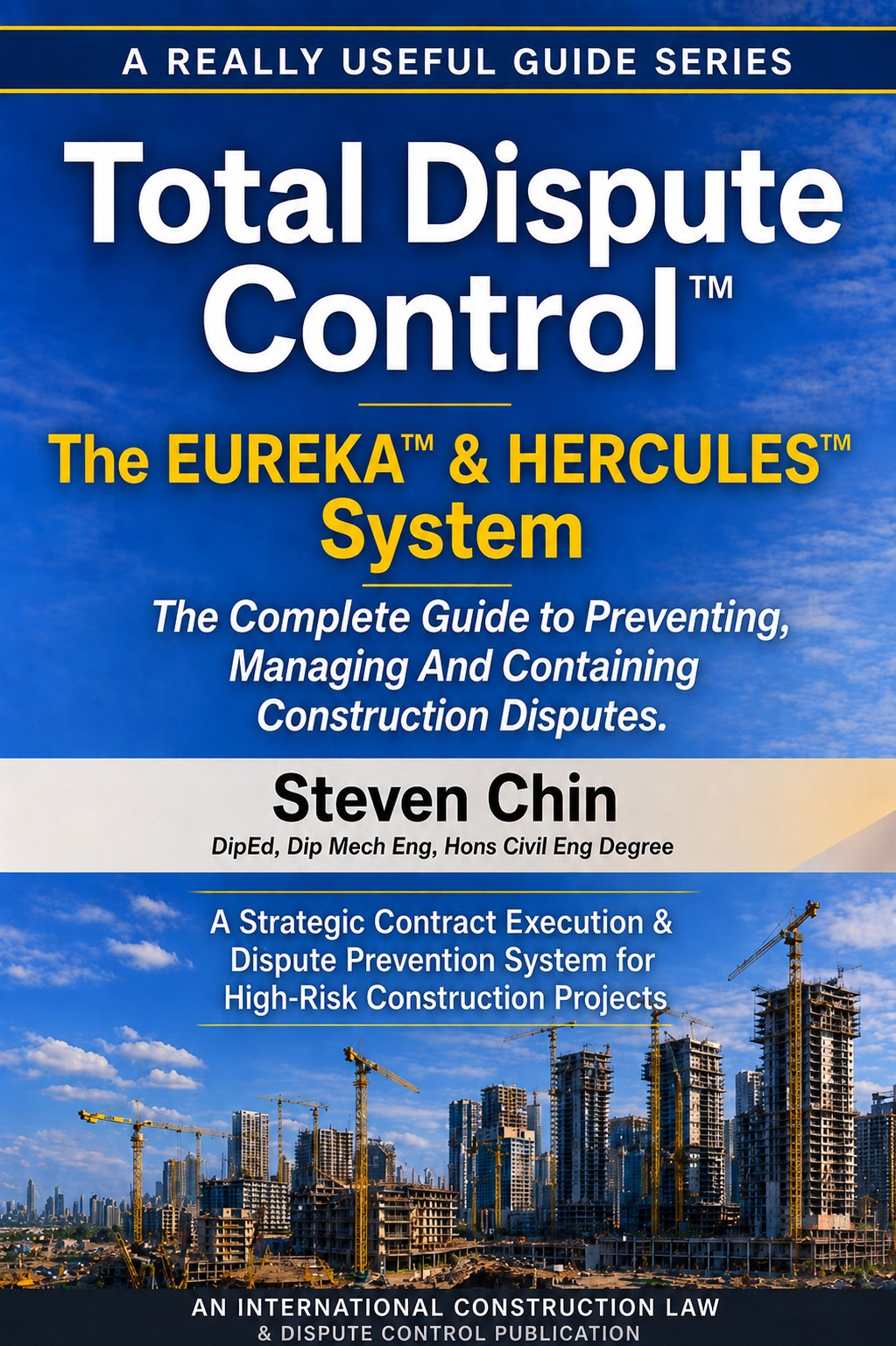
Total Dispute Control™
One-Line Description
Total Dispute Control™ is a comprehensive project execution and dispute prevention system that equips construction professionals with the tools, processes, and strategies needed to prevent disputes, protect entitlements, and maximise commercial success throughout the project lifecycle.
Read Executive Summary
Total Dispute Control™ is a strategic construction management and contract execution framework designed to help contractors, developers, consultants, and project owners prevent, manage, contain, and successfully resolve construction disputes before they escalate into costly claims, arbitration, or litigation.
Unlike traditional claims management approaches that react after problems arise, the Total Dispute Control™ System adopts a proactive methodology by identifying dispute triggers at the earliest stages of a project and implementing structured controls to prevent them from developing into major commercial disputes.
The book introduces two integrated methodologies:
The EUREKA™ System
A project intelligence and early-warning framework that enables project teams to identify contractual blind spots, hidden liabilities, notice failures, risk-transfer mechanisms, documentation weaknesses, and emerging dispute triggers before they become critical problems.
The HERCULES™ System
A dispute containment and recovery framework designed to strengthen a contractor's contractual position, preserve entitlements, improve evidential records, manage claims effectively, and enhance the probability of achieving successful commercial outcomes when disputes become unavoidable.
Core Philosophy
Most construction disputes are not caused by bad projects. They are caused by poor contract execution, inadequate documentation, late notices, unmanaged risks, contractual blindness, and the failure to recognize dispute triggers early enough.
By applying the Total Dispute Control™ framework, project teams can transform disputes from unpredictable threats into manageable commercial risks.
What the Book Covers
The guide provides practical strategies for:
- Contract risk identification and mitigation
- Early detection of dispute triggers
- Prevention of contractual blindness
- Effective contract administration
- Notice and entitlement management
- Documentation and evidence preservation
- Variation and change management
- Delay and disruption management
- Claims preparation and defence
- Commercial risk containment
- Dispute avoidance techniques
- Strategic dispute resolution
Who Should Read This Book
The book is particularly valuable for:
- CEOs and Managing Directors
- Project Directors
- Project Managers
- Contract Managers
- Commercial Managers
- Quantity Surveyors
- Planning Engineers
- Site Managers
- Claims Consultants
- Construction Lawyers
- Senior Executives responsible for project delivery
especially those involved in:
- Data Centre Construction
- Infrastructure Projects
- EPC Contracts
- Industrial Developments
- High-Risk Construction Projects
- Mega Projects
Key Benefits
Readers will learn how to:
- Reduce dispute exposure
- Improve project profitability
- Protect contractual entitlements
- Strengthen commercial positioning
- Improve claim success rates
- Prevent unnecessary financial losses
- Avoid common contractual traps
- Establish a project-wide dispute prevention culture
- Improve overall project governance and control
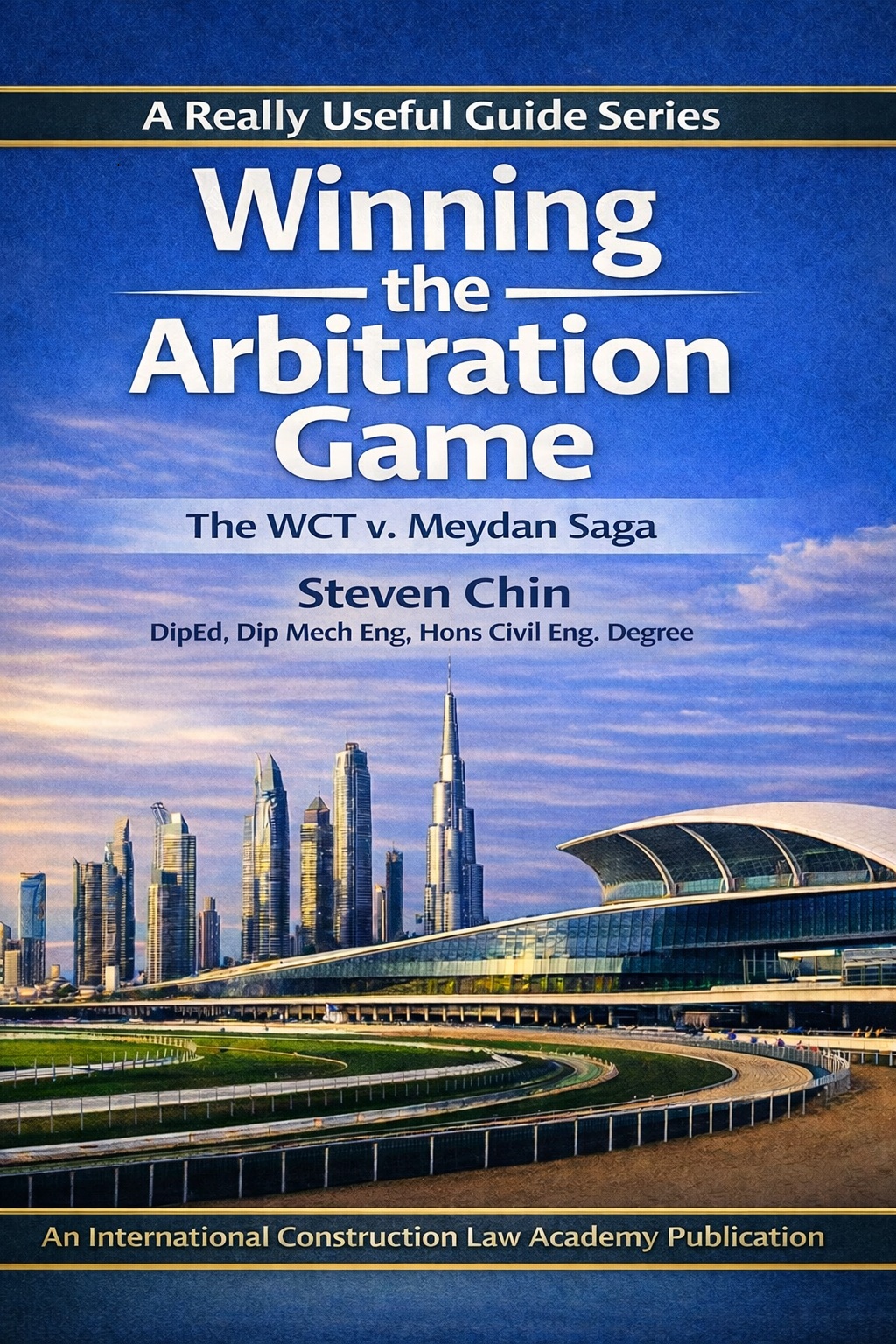
Winning the Arbitration Game™
One-Line Description
Winning the Arbitration Game™ is a practical contractor's guide that reveals why enforcement—not arbitration—is the real dispute, and how disciplined claim design can transform an arbitration award into actual payment.
Read Executive Summary
Winning the Arbitration Game™ is not a book about arbitration law. It is a book about the harsh commercial reality that winning an arbitration does not necessarily mean getting paid. Through the real-life WCT v. Meydan arbitration, the book demonstrates why enforcement—not the arbitration award itself—is the true battleground in major construction disputes.
The book follows the collapse of the AED 4.6 billion Meydan Racecourse project in Dubai and examines how WCT successfully navigated one of the most important yet misunderstood aspects of dispute resolution: designing a claim that can survive enforcement scrutiny and ultimately convert into money.
Core Philosophy
The objective of arbitration is not to win the argument. The objective is to get paid.
Many contractors mistakenly focus on proving entitlement, demonstrating loss, and securing the largest possible award. The book shows that this instinct often leads to enforcement difficulties, delayed recovery, reduced settlements, or complete failure to collect.
The Central Lesson
The WCT case demonstrates the power of what the author calls the "50% Strategy."
Following the withdrawal of one of the joint venture partners during arbitration, WCT deliberately chose not to pursue 100% of the claim. Instead, it restricted its claim to the portion it could clearly and unquestionably establish ownership over. This disciplined approach significantly reduced enforcement risk and ultimately contributed to a successful recovery.
The book argues that:
- Ownership is more important than loss.
- Enforceability is more important than claim size.
- Certainty is more important than ambition.
- Payment is more important than victory.
What the Book Covers
The guide provides practical insights into:
- Mega project failures
- Joint venture dispute risks
- Termination and post-termination strategy
- Arbitration versus enforcement realities
- The New York Convention
- Double recovery risks
- Enforcement challenges in different jurisdictions
- UAE court attitudes towards arbitration awards
- Claim design strategies
- Settlement leverage
- Award enforcement
- Commercial dispute survival techniques
Particular emphasis is placed on the distinction between:
- Losing money versus owning a claim
- Winning an award versus receiving payment
- Arbitration strategy versus enforcement strategy
- Legal success versus commercial success.
Key Lessons for Contractors
The book teaches contractors to:
- Design disputes backwards from enforcement.
- Only claim what they can clearly own.
- Anticipate joint venture fragmentation.
- Understand enforcement geography before commencing arbitration.
- Avoid over-claiming.
- Prioritise enforceability over headline numbers.
- Build claims that courts can comfortably enforce.
- Focus on recovery rather than righteousness.
Courts are not concerned with fairness. Courts are concerned with certainty and avoiding risk.
Who Should Read This Book
The book is particularly valuable for:
- Contractors
- Project Directors
- Contract Managers
- Commercial Managers
- Quantity Surveyors
- Claims Consultants
- Construction Lawyers
- Joint Venture Partners
- CEOs and Managing Directors involved in major projects
especially those working on:
- Mega Projects
- Infrastructure Projects
- EPC Projects
- Public Sector Developments
- International Construction Projects
Key Benefits
Readers will learn how to:
- Improve claim recoverability
- Reduce enforcement risks
- Structure disputes strategically
- Manage joint venture disputes more effectively
- Improve settlement leverage
- Understand how courts think
- Maximise actual recovery rather than theoretical entitlement
- Avoid the common traps that destroy otherwise successful claims
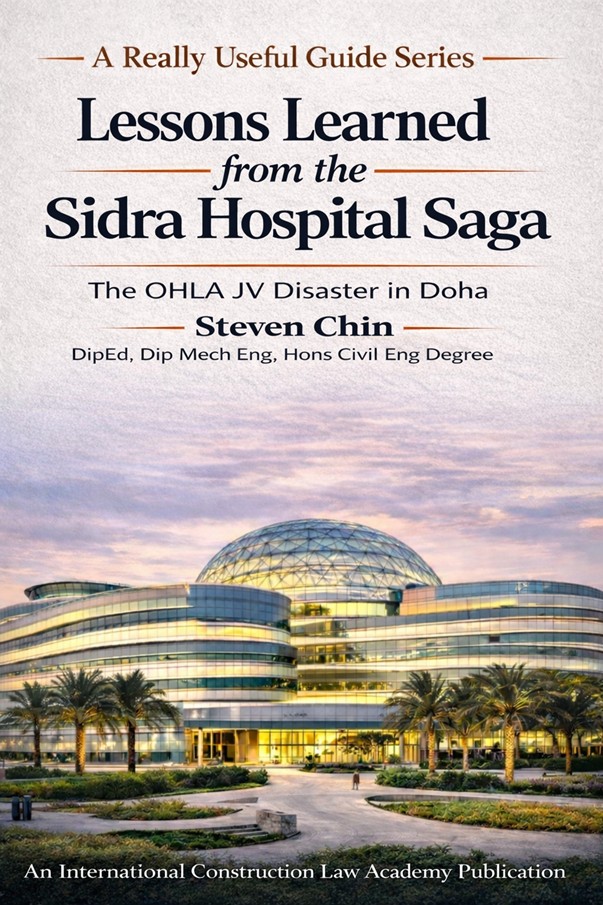
Lessons Learned from the Sidra Hospital Saga™
One-Line Description
Lessons Learned from the Sidra Hospital Saga™ is a practical contractor's guide that reveals how major construction claims are lost through weak entitlement management, inadequate documentation, and poor evidential discipline—and how these failures can be prevented before arbitration begins.
Read Executive Summary
Lessons Learned from the Sidra Hospital Saga™ is a strategic construction dispute and contract management guide that examines one of the largest healthcare infrastructure arbitrations in the Middle East and explains why major contractor claims often collapse despite years of effort, substantial expenditure, and genuine project difficulties.
Through the OHLA–Contrack Joint Venture's experience on the £1.9 billion Sidra Hospital project in Qatar, the book demonstrates how legal entitlement is frequently lost during project execution long before arbitration begins. The case reveals that arbitration rarely rewards effort, hardship, or good intentions. Instead, it rewards contractors who preserve entitlement, document causation, protect evidence, and maintain contractual discipline throughout the project lifecycle.
Core Philosophy
Most construction claims do not fail because contractors are wrong. They fail because entitlement, causation, and evidence were not protected when the events occurred.
The author argues that contractors often become so focused on solving project problems that they unknowingly destroy the very claims they may later rely upon for recovery.
The Central Lesson
The Sidra Hospital dispute demonstrates how a project can appear operationally under control while its legal position deteriorates quietly in the background.
The book identifies six recurring failure mechanisms:
- Design responsibility that silently migrates to the contractor.
- Scope drift disguised as clarification.
- Delay that exists operationally but cannot be proven legally.
- Disruption that is felt commercially but remains unmeasured.
- Recovery efforts that destroy entitlement.
- Termination that becomes legally defensible through documentation.
By the time arbitration begins, many outcomes have already been determined by decisions made years earlier during project execution.
What the Book Covers
The guide provides practical lessons on:
- Design-and-build risk allocation
- Fit-for-purpose obligations
- Performance-based specifications
- Scope creep and variation management
- Delay and concurrency
- Productivity loss and disruption
- Recovery and acceleration
- Termination management
- Arbitration strategy
- Evidential discipline
- Tribunal behaviour and decision-making
- Claim preservation techniques
Key Lessons for Contractors
Lock Design Responsibility Before It Expands
Contractors must clearly define:
- Acceptance criteria
- Performance standards
- Design assumptions
- Responsibility boundaries
Failure to do so can result in contractors unknowingly accepting obligations far beyond their original scope.
Protect Variations Before Performing the Work
The book demonstrates how additional work frequently becomes non-recoverable when it is treated as a clarification rather than a variation.
Contractors must reserve rights early, document changes properly, and avoid allowing scope expansion to become absorbed into the original contract.
Treat Delay as a Legal Case, Not a Project Condition
The existence of delay alone is insufficient.
Contractors must prove:
- Cause
- Responsibility
- Impact on completion
Without these elements, even genuine delays may fail in arbitration.
Measure Disruption While It Happens
The book shows that overtime, additional manpower, and project stress are not compensable simply because they occurred.
Disruption must be measured, attributed, and documented contemporaneously if recovery is to be achieved.
Recovery Can Destroy Claims
The harder a contractor works to save the project, the harder it may become to prove entitlement later.
Acceleration, resequencing, and recovery efforts often absorb delay and destroy the evidence required for successful claims.
Termination Is Usually Lost Months Before It Happens
Termination is rarely decided by the termination notice itself.
It is usually determined by:
- Prior correspondence
- Cure notices
- Responses to allegations
- Documentary records
By the time termination occurs, the legal position has often already been established.
Who Should Read This Book
The book is particularly valuable for:
- Contractors
- Project Directors
- Project Managers
- Contract Managers
- Commercial Managers
- Quantity Surveyors
- Planning Engineers
- Claims Consultants
- Construction Lawyers
- Design-Build Contractors
especially those involved in:
- Hospitals
- Data Centres
- Infrastructure Projects
- EPC Projects
- Industrial Facilities
- High-Performance Buildings
Key Benefits
Readers will learn how to:
- Preserve contractual entitlement
- Avoid silent risk transfer
- Protect variation claims
- Strengthen delay recovery
- Improve disruption claims
- Manage acceleration properly
- Respond effectively to termination threats
- Improve arbitration readiness
- Reduce claim attrition
- Strengthen dispute outcomes
The Book's Most Important Message
Arbitration does not reward effort, hardship, cooperation, or good intentions. It rewards contractors who preserve entitlement, document causation, protect evidence, and maintain contractual discipline from the first day of the project until the last.